Clinical role: after orthotopic heart transplant (OHT), belatacept is an off-label, multidisciplinary rescue or CNI-sparing adjunct for carefully selected EBV-seropositive recipients—not routine first-line maintenance. ISHLT allows rescue after standard approaches fail (Class IIb, Level C). Heart-specific dosing and comparative efficacy remain unestablished.
A
What it changes—and what it does not prove
signal 2 blockade2 · Belatacept occupies CD80/86
- Biologic rationale CTLA4-Ig binds CD80/CD86 and prevents CD28-mediated T-cell costimulation.
- Regulatory boundary approved only for prophylaxis of rejection in adult kidney transplantation. Efficacy and safety in other organs are not established.
- Why consider substantial CNI toxicity—especially renal dysfunction, thrombotic microangiopathy (TMA), or neurotoxicity—after reversible causes and conventional minimization options are addressed.
- Not established de novo routine OHT use, rapid or universal CNI withdrawal, treatment of active ACR/AMR, elimination of established DSA, prevention/regression of CAV, or survival benefit.
- Kidney evidence ≠ heart evidence BENEFIT established renal-transplant efficacy with better renal function but more early rejection versus cyclosporine. This supports biologic plausibility, not an OHT regimen.
B
Use only through a defined decision pathway
no ad hoc conversion1 · Confirm the problemCNI-attributable toxicity or unusual immunologic need. Document alternatives tried.
2 · Pass hard gatesEBV VCA-IgG and EBNA-IgG positive. No uncontrolled infection or active rejection.
3 · Lock the regimenCompanion drugs, CNI trajectory, infusion access, payer approval, surveillance, and rescue plan.
4 · Time-limit the trialDefine renal/immunologic goals and 3-, 6-, and 12-month continue/stop criteria.
C
Clinical use lanes
indication changes the risk| Proposed lane | When the rationale is strongest | Guardrail |
|---|---|---|
| Renal / chronic CNI toxicity | Progressive dysfunction with plausible CNI contribution after hemodynamic, obstructive, drug-interaction, infection, and intrinsic-kidney causes are evaluated | Measure benefit by renal trajectory and achieved CNI reduction. Improvement is not guaranteed |
| TMA / severe neurotoxicity | CNI must be stopped urgently and mTOR is unsafe or intolerable. Limited to multidisciplinary rescue | Case-level evidence. Create immediate replacement coverage and intensified EMB surveillance |
| Sensitization / DSA concern | Exceptional HLA-reviewed adjunct after the phenotype and standard options are defined | No proof of treating established DSA or AMR. Do not stack four full-dose agents without a net-immunosuppression plan |
| De novo / early OHT | Clinical trial or extraordinary low-risk use with research-like selection and follow-up | No completed randomized results. Avoid translating a trial schedule into routine care |
| Adherence / convenience | Infusion reliability may make one component observable | Monthly IV dosing does not ensure adherence to CNI, MPA, steroid, prophylaxis, labs, or biopsy. Convenience alone is not an indication |
Decision sentence: “The target problem is ___. Evidence that CNI is causal ___. Conventional options attempted/unsafe ___. Intended belatacept lane ___. Benefit endpoint ___. Competing rejection/infection/access risk ___.”
Use boundary: evidence-informed educational reference, not an approved prescribing protocol or order set. Every use needs transplant-attending and transplant-pharmacist governance. Add ID/HLA input when infection or immunologic risk drives the decision.
Fact-check boundary: reviewed 17 Oct 2026. No randomized OHT results were identified. Oren 2024 and Baranowska 2025 are reports from the same center with overlapping study periods. Do not assume independent populations or add their sample sizes.
| Evidence | Population / strategy | Observed signal | What it cannot establish |
|---|---|---|---|
| Launay 2020 n=40 | French multicenter. EBV+. Mostly renal rescue. Early and late starts. Frequent CNI discontinuation | Mean eGFR improved rapidly (~59% at 1 month). 2R/3R rejection, including fatal rejection. One fatal fungal infection. Four low-level dnDSA. | Uncontrolled, heterogeneous regimen and surveillance. Renal recovery does not prove rejection safety. |
| Oren 2024 n=21 | Single center, start ~23 months. Sensitization/DSA or renal sparing. Generally reduced-dose CNI | One rejection within 1 year. Renal change not significant. Infections 11/21, with 4 infection-related discontinuations. Overall, 7/21 discontinued. | Feasibility only. Same center and overlapping study era as the n=64 report. |
| Baranowska 2025 n=64 | Same center, expanded 2019–2023 cohort. Propensity-matched controls. Median start 20 months | Rejection-free survival similar (P=.44). eGFR 38→43 mL/min/1.73 m² (P=.04). Infection 20%. EBV DNAemia 7.8% before vs 40.6% after initiation. Median follow-up 26 months. | Residual confounding and survivor selection preclude noninferiority, PTLD-safety, or survival claims. |
| Magua 2025 12 vs 48 | Matched single-center HT/HKT cohort. Start ~day 90. 5 mg/kg monthly. Low-dose tacrolimus retained | After day 85: dnDSA 0/12 vs 9/48 (log-rank P=.12). No significant ACR/AMR, renal, or CMV differences through 18 months. | Underpowered. Supports adjunctive feasibility, not DSA prevention or CNI-free equivalence. |
| NCT04477629 planned n=12 | NYU phase 2 single-arm de novo pilot. Kidney-style loading and tacrolimus withdrawal months 7–9 | Registry still lists recruiting and no results. Last update 4 Dec 2025. Sep 2026 completion was estimated, not confirmed. | No clinical inference before results. Too small for comparative efficacy. |
| RTB-013 planned n=66 | Recruiting randomized phase 2. Belatacept + delayed tacrolimus withdrawal versus tacrolimus SOC | Recruiting, no results. Record updated 9 Oct 2026. Estimated primary completion Jan 2028. | Its careful selection and 9-month withdrawal must not be generalized into rapid conversion. |
A
Certainty by outcome
calibrate the claim| Outcome | Current confidence | Defensible conclusion |
|---|---|---|
| Renal recovery | Low–very low | Improvement observed in selected rescue cohorts. CNI reduction, postoperative recovery, and selection may explain part of the change. No universal benefit is established. |
| ACR / AMR | Very low | Manageable rates are possible with careful selection and retained/slowly withdrawn tacrolimus. Moderate, severe, and fatal rejection have occurred. |
| DSA / EBV / infection | Very low | DSA signal is hypothesis-generating. EBV DNAemia increased in the largest cohort. Infection—including fatal infection—is a material class/total-burden hazard. |
| CAV / survival | Insufficient | No demonstrated prevention, regression, or survival advantage. |
B
Read the DSA signal with its denominator
observational comparison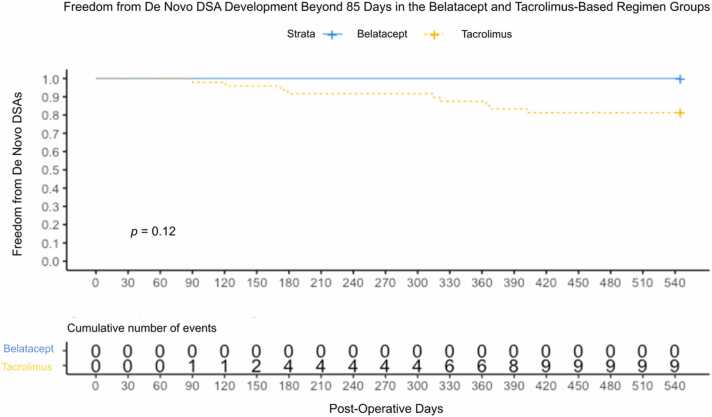
0/12 vs 9/48 after day 85. Follow-up ends at 18 months after transplant. This small comparison does not prove prevention or exclude a clinically important difference.
The lower panel shows cumulative events, not numbers at risk. Pre-day-85 DSA belongs to baseline. The comparison evaluates the whole regimen, including retained tacrolimus.
© 2025 Magua W, Wang M, Pobee D, et al. Figure 3, reproduced unchanged under CC BY 4.0.
Select the figure to enlarge.
Transferability check: match timing, reason for conversion, companion drugs, CMV risk, and surveillance. Early postoperative renal recovery differs from late CNI rescue. Different infection definitions and follow-up prevent direct rate comparisons between cohorts.
Evidence sentence: “Available OHT evidence is observational. The closest cohort to this phenotype is ___ because ___, but differences in timing, indication, CNI exposure, and surveillance limit transferability.”
Language discipline: say “observed,” “associated,” or “feasible.” Do not say noninferior, renal-protective for every patient, prevents DSA/CAV, or improves survival.
Do not give belatacept if EBV seronegative or unknown. “EBV positive” means evidence of acquired immunity with IgG to both viral capsid antigen (VCA) and EBV nuclear antigen (EBNA). EBV PCR does not substitute for eligibility serology.
A
Best-fit phenotype
rescue after alternatives- Most defensible clinically meaningful CNI toxicity—progressive renal dysfunction, CNI-associated TMA, or serious neurotoxicity—after reversible causes, interactions, trough variability, hemodynamics, obstruction, and other kidney disease are assessed.
- Alternatives considered safer CNI exposure, adherence/interaction repair, antimetabolite optimization, or mTOR strategy where feasible and appropriate.
- Stable platform recent acceptable EMB, stable graft function, no active hemodynamic compromise, no rising DSA, and no uncontrolled infection.
- Exceptional adjunct unusual immunologic need reviewed with the HLA team. Belatacept is not a substitute for proven ACR/AMR treatment.
- Operational fit reliable infusion attendance, adherence to companion therapy, laboratory/biopsy access, insurance approval, transport, and a backup immunosuppression plan.
- Time-defined trial baseline eGFR slope/proteinuria, CNI exposure/toxicity, DSA/rejection history, and a measurable goal documented before dose 1.
B
Stop versus defer
local governance layer| Hard stop | Defer / very high caution | Resolve before start |
|---|---|---|
| EBV VCA-IgG or EBNA-IgG negative, indeterminate, or unavailable. Prior serious hypersensitivity to belatacept/excipients | Active ≥2R ACR, clinically significant AMR, allograft dysfunction, rising DSA, or very recent rejection requiring T-cell depletion | Establish graft stability and a treatment plan. Do not use belatacept as rescue monotherapy |
| — | Uncontrolled serious infection. Untreated latent/active TB. Unexplained EBV or CMV DNAemia. Suspected PTLD/lymphoma/PML | Transplant ID review, infection treatment, viral trajectory, and prophylaxis plan |
| — | High immunologic risk with intended CNI withdrawal. Early de novo use outside a study. CMV D+/R−, which RTB-013 excludes | Individualized HLA/ID review. Understand that trial eligibility was far narrower than routine OHT practice |
| — | Pregnancy/lactation. Planned live vaccine. Uncontrolled malignancy. Unreliable access, adherence, or payer coverage | Specialty counseling, immunization/access plan, and documented alternative if infusions fail |
C
Pre-dose-1 bundle
one signed plan| Domain | Minimum baseline record |
|---|---|
| Allograft / immune | OHT date/type. Induction. ACR/pAMR and DSA chronology. Recent EMB and its timing agreed by the transplant team, echo. RHC if physiologic concern. Current CAV assessment |
| Infection / malignancy | EBV VCA-IgG + EBNA-IgG. Baseline EBV PCR. Donor/recipient CMV status + PCR. TB screen. HBV/HCV/HIV and endemic-infection review as indicated. Malignancy/skin history |
| Laboratory / medication | CBC, CMP/eGFR, liver tests, urinalysis/proteinuria when renal indication. Weight. Tacrolimus exposure/variability. Full interaction and adherence review |
| Execution | Named transplant attending + pharmacist. Indication. Companion regimen. CNI plan. Surveillance calendar. Infusion site. Authorization. Missed-dose/PLEX/illness bridge. Stop criteria. Informed consent |
D
Two reality checks before approval
causal kidney phenotype · trial gap- Is CNI the kidney problem? Review congestion/low output, MAP, tacrolimus exposure and interacting drugs, proteinuria/urine sediment, obstruction, diabetes/vascular disease, infection, and intrinsic CKD.
- Predefine failure worsening proteinuria, continued eGFR decline despite lower CNI, dialysis trajectory unchanged, or toxicity shifted to the companion regimen.
- RTB-013 benchmark primary isolated OHT, negative crossmatch, no prior desensitization, pre-OHT eGFR >30 mL/min/1.73 m², EBV VCA/EBNA positive, no induction, and no CMV D+/R−—far narrower than many rescue candidates.
- Inference the trial’s slow 9-month tacrolimus withdrawal and low-risk design argue against a routine one-month CNI stop.
Do not confuse absence of reported PTLD with safety. The largest cohort was still small and showed a marked increase in EBV DNAemia. The boxed PTLD/CNS risk remains governing.
Order-set warning: do not copy the kidney label or any cohort schedule into OHT care without a recipient-specific, pharmacist-verified plan. There is no therapeutic trough target and no validated OHT re-loading, missed-dose, or plasma-exchange replacement algorithm.
A
Schedules found in the evidence
map, not recommendation| Context | Published / registered schedule | Critical boundary |
|---|---|---|
| FDA kidney label | 10 mg/kg IV day 1 and 5. End weeks 2, 4, 8, 12 → 5 mg/kg q4 weeks ±3 days from week 16. | Adult kidney indication with basiliximab, MMF, and steroids. not an approved OHT schedule. |
| French OHT cohort | Kidney-like 10 mg/kg loading followed by 5 mg/kg monthly. Timing and CNI modification varied. | Renal signal accompanied by clinically important and fatal rejection/infection. |
| Emory OHT cohort | 5 mg/kg IV monthly (±5 days) from approximately day 90 without loading. Low-dose tacrolimus retained and tapered gradually. | Selected small cohort. Does not validate monthly-only initiation for other phenotypes. |
| NCT04477629 | Kidney-style loading. Planned tacrolimus withdrawal over months 7–9. | Single-arm pilot with no posted results at the 17 Oct 2026 registry check. |
| RTB-013 | 10 mg/kg days 3, 7, 16, 30, 58, 86 → 5 mg/kg q28 days ±3. Tacrolimus withdrawal over 9 months. | Randomized research regimen in stringently selected low-risk de novo OHT. No results. |
| TMA case report | 10 mg/kg every 2 weeks for 2 months, then nonstandard 6 mg/kg monthly with MMF/steroid. | Single rescue case. Biologic plausibility only. |
B
Safer transition principles
protect the graft first- Conservative approach when clinically feasible, add belatacept to a stable background and retain reduced, measured CNI exposure while response and rejection surveillance accrue.
- Change one axis at a time avoid simultaneous CNI withdrawal, steroid taper, and antimetabolite reduction.
- Companion regimen usually an antimetabolite plus corticosteroid, individualized for cytopenia, infection, GI tolerance, malignancy, and prior rejection.
- CNI-free reserve for compelling intolerance/toxicity with intensified surveillance or a research protocol. Never infer safety from a creatinine response alone.
- Emergency CNI cessation TMA/PRES or other life-threatening toxicity requires an attending/pharmacist-defined bridge. Belatacept onset and evidence do not justify an unprotected gap.
- No universal taper set trough targets and step timing from time post-OHT, prior rejection/DSA, graft function, reason for conversion, and total immunosuppression.
C
Preparation & administration facts from the label
pharmacy verification| Dose calculation | Kidney label: actual weight at transplantation, revised if weight changes >10%. Round to nearest 12.5 mg. For late OHT conversion, document the pharmacist-approved reference weight. | Infusion | IV over 30 minutes through a 0.2–1.2 μm low-protein-binding filter and a separate line. No routine premedication required. |
| Preparation | 250-mg vial. Use supplied silicone-free syringe. Inspect solution and follow current label/pharmacy procedure. | Exposure | Do not increase dose/frequency to “catch up”. Higher cumulative exposure raises serious infection, malignancy, and CNS-event concern. |
D
Pharmacokinetics & interactions
kidney-label facts| Fact | Clinical implication |
|---|---|
| Long biologic exposure | Mean terminal half-life after repeated 5-mg/kg dosing in kidney recipients was 8.2 ±2.4 days. There is no established OHT concentration target or routine belatacept TDM. |
| Renal function / dialysis | Renal function and concomitant dialysis did not affect clearance in the kidney population. The label provides no renal dose adjustment. This does not validate an OHT schedule or a TPE replacement dose. |
| CYP interactions | No relevant effect on tested CYP1A2, 2C9, 2C19, 2D6, or 3A substrates. Interaction risk still comes from companion immunosuppressants, anti-infectives, and net immunosuppression. |
| MMF / MPA | Cyclosporine suppresses MPA enterohepatic recirculation whereas belatacept does not. When switching between them, reassess MPA toxicity/exposure and MMF dose. Label data showed higher dose-normalized MPA exposure with belatacept. |
| Vaccines / reproductive care | Avoid live vaccines during treatment. Pregnancy requires transplant and maternal-fetal-medicine review. The label advises choosing between nursing and the drug, considering the need for treatment. Do not stop immunosuppression without a replacement plan. |
Medication-reconciliation pearl: CNI reduction often triggers anti-infective or antihypertensive changes. Recheck the companion drug and tacrolimus plan whenever azoles, macrolides, diltiazem/verapamil, rifamycins, anticonvulsants, or other major interactors change.
Principle: surveillance intensity follows immunologic risk + speed/depth of CNI reduction + time post-OHT. A normal creatinine, echo, dd-cfDNA, or gene-expression profile does not by itself exclude rejection under a novel regimen. Biopsy remains central when clinical or immunologic concern exists.
A
Build surveillance around each regimen change
requires local approval| Clock | Allograft / immune | Safety / infection | Decision |
|---|---|---|---|
| Baseline | Recent EMB with timing agreed by the transplant team, echo, DSA. RHC if physiologic concern. Document CAV context | CBC, CMP/eGFR, liver tests, urine protein when renal indication. EBV VCA/EBNA + PCR. CMV status/PCR. TB and infection screen | Confirm indication, companion regimen, CNI trajectory, goals, and stop/bridge plan |
| Weeks 1–8 | Clinical/echo assessment. Schedule EMB/DSA around CNI changes according to graft risk. Recheck CNI troughs after dose or interaction changes | Every infusion: symptoms, neurologic screen, infection, adherence. CBC/CMP/eGFR/LFT and EBV PCR at intervals set before treatment. CMV PCR by risk/pathway | Do not deepen CNI reduction if graft, DSA, infection, or access trajectory is uncertain |
| Months 3–6 | Plan repeat EMB/echo/DSA around major CNI reduction and routine OHT surveillance. Test sooner for symptoms, DSA, or biomarker change | Routine laboratory and EBV/CMV surveillance tailored to prior results and net immunosuppression. Agree who reviews each result | At 3 and 6 months: renal slope/toxicity improved? rejection-free? infection/viral burden acceptable? |
| After 6 months | Return only cautiously toward the center’s standard OHT surveillance. Continue DSA surveillance by OHT risk | Continue routine labs and risk-based viral surveillance. No validated belatacept-specific OHT EBV interval or action threshold exists | At 12 months: continue only if benefit remains clinically meaningful and burden/risks acceptable |
| After full CNI withdrawal or major delay | Lower threshold for EMB, DSA, echo, and hemodynamics. Plan objective graft reassessment after full withdrawal with timing set before the change | Verify companion-drug exposure and infection/viral status | Pause further de-escalation until objective graft stability is demonstrated |
B
Signals and actions
trend, do not threshold-shop| Signal | Interpretation | Action |
|---|---|---|
| Rising creatinine / no renal response | May reflect irreversible CKD, hemodynamics, rejection, infection, obstruction, or non-CNI disease | Re-phenotype. Do not keep reducing CNI solely because belatacept was started |
| New/rising DSA, biomarker, or graft change | Potential ACR/AMR or under-immunosuppression | Expedited echo/EMB ± RHC and HLA review. Hold taper. Treat established rejection by the current OHT pathway |
| EBV DNAemia | Risk marker, not a stand-alone PTLD diagnosis. Assay and kinetics matter | Repeat/confirm trajectory. Symptoms/exam/imaging as indicated. ID/hematology review. Review total immunosuppression and whether to hold belatacept case by case. No universal cutoff |
| CMV / opportunistic infection | Total immunosuppression and donor/recipient risk drive hazard | Treat, reassess prophylaxis and overall burden, and define replacement coverage before holding any agent |
C
Prevention and infusion-day micro-check
do before drug release| Domain | Before / during therapy | At every infusion |
|---|---|---|
| CMV / PJP | Set CMV strategy from D/R status and recent lymphocyte depletion. Decide whether late conversion warrants starting/extending CMV or PJP prophylaxis with transplant ID | Fever, GI/pulmonary symptoms, antimicrobial use, PCR trajectory, prophylaxis adherence |
| TB / endemic / vaccines | Evaluate TB and treat latent infection before belatacept. Exposure-based endemic review. Give indicated non-live vaccines when feasible. Avoid live vaccines | New exposures, travel, vaccine plans, active infection, wound or planned procedure |
| PTLD / PML / malignancy | Skin and age-appropriate cancer screening. Record prior PTLD/lymphoma and recent T-cell depletion | Lymphadenopathy, fever, weight loss/night sweats, skin lesion, headache, cognition/behavior, focal deficit, seizure, vision/gait change |
| Regimen integrity | One current medication list, CNI target/step, MPA/steroid dose, authorization, infusion site, backup plan | Actual doses taken, trough/labs/EMB/DSA reviewed, missed infusion, pregnancy status when relevant, upcoming PLEX/procedure |
Program build items: define lab/biopsy orders, EBV/CMV assay ownership, infusion-day checklist, after-hours escalation, prophylaxis duration, and a single clinician responsible for each CNI step. The kidney label recommends CMV prophylaxis for at least 3 months and PJP prophylaxis after transplant. OHT conversion requires a separate risk-based plan.
A
Event-to-action table
attending + pharmacist| Event | Immediate action | Immunosuppression implication |
|---|---|---|
| Infusion reaction / anaphylaxis | Stop infusion. Emergency treatment and monitoring. Report severe reaction | Discontinue after anaphylaxis and activate the prewritten alternative regimen. Do not routinely rechallenge |
| New neurologic, cognitive, or behavioral change | Urgent evaluation for CNS PTLD, PML, infection, stroke, seizure, and metabolic causes | Hold belatacept while evaluated. Coordinate transplant ID/hematology/neurology. Preserve graft coverage |
| Serious or opportunistic infection | Culture/image/treat. Define severity and source. Assess CMV/EBV and other pathogens by phenotype | Rebalance total immunosuppression. Any hold requires named replacement and restart criteria |
| Suspected ACR/AMR or new DSA | Urgent EMB ± RHC/echo and HLA evaluation. Treat confirmed rejection by current OHT standards | Stop CNI taper. Belatacept is not acute rejection treatment. Consider discontinuation after significant breakthrough rejection |
| Missed / delayed infusion | Contact transplant program the same day. Assess delay, adherence, companion therapy, symptoms, and CNI exposure | Do not double or invent a loading dose. Resume as soon as program-directed. Larger/repeated delays may warrant bridge, DSA/EMB, or schedule reset |
| Plasma exchange | Give after exchange when feasible and involve transplant pharmacy | No validated OHT replacement-dose algorithm. Pause taper and individualize supplemental dosing/monitoring |
| Access / payer failure | Escalate before the due date. Verify site, authorization, transport, drug supply | Use the documented bridge or revert to a tolerable regimen—never allow an administrative gap |
| No meaningful benefit | At 3–6 months reassess renal slope, CNI toxicity, graft stability, infections, viral burden, and treatment burden | Discontinue if goals are not met or harm outweighs benefit. Taper/replace through a written plan |
B
Continue / stop checkpoints
document the balance- Continue only if the intended benefit is measurable. Graft function/EMB/DSA remain acceptable. Infection and viral burden are controlled. Infusion access is reliable. Total immunosuppression is rational.
- Renal endpoint use eGFR/creatinine slope, proteinuria, CNI exposure, dialysis trajectory, and the competing kidney diagnosis—not one post-dose value.
- Stop / redesign for significant breakthrough rejection, progressive DSA/AMR, suspected PTLD/PML, recurrent serious infection, intolerable infusion reaction, no target-organ benefit, or unreliable delivery.
- After stopping explicitly document replacement immunosuppression, timing, trough/lab goals, EMB/DSA plan, and which team owns the transition.
C
Consent and handoff
plain language + exact plan| Discuss | Record |
|---|---|
| Off-label uncertainty | No approved heart-transplant indication or proven best OHT dose. Small retrospective studies. Randomized trials ongoing. |
| Tradeoff | Possible reduction in CNI toxicity/renal burden versus rejection, infection, EBV/PTLD/CNS, malignancy, infusion, and access risks. |
| Non-negotiables | Attend every infusion/lab/biopsy. Never stop companion drugs. Call immediately for fever, graft/HF symptoms, neurologic change, lymphadenopathy, weight loss, or a missed dose. |
Copy-ready plan sentence: “Belatacept considered for ___ after ___ failed/was unsafe. EBV VCA-IgG and EBNA-IgG ___. Graft/DSA/infection baseline ___. Regimen ___. CNI trajectory ___. Monitoring and infusion owner ___. Bridge/stop criteria ___. Benefit reassessment at ___.”
D
Minimum program adoption gate
before first therapy planClinical governanceNamed OHT attending, pharmacist, ID/HLA reviewers. Approved indication and exception process.
Orders & surveillanceCorrect product build, weight/rounding/filter instructions, labs, EMB/DSA/viral calendar, CNI-step ownership.
ContinuityAuthorization, infusion location, transportation, after-hours contact, missed-dose/PLEX and shortage bridge.
Learning systemTrack indication, regimen, CNI exposure, renal trajectory, ACR/AMR/DSA, EBV/CMV, infection, discontinuation, and death.
Patient explanation: “This IV medicine is approved for kidney transplant, not heart transplant. We are considering it to reduce harm from your current anti-rejection medicine. Heart evidence is limited, so we will keep other protection in place and monitor closely for rejection, infection, and EBV-related complications.”