Lower the cause
Reduce atherogenic LDL exposure. The achieved LDL reduction helps explain how much relative benefit to expect. Baseline risk and duration determine the absolute benefit.
Statins deserve a strong recommendation when the patient's cardiovascular risk warrants treatment. Their value is demonstrated in randomized trials: fewer major vascular events, with survival benefit established in coronary disease and supported by pooled evidence. The case rests on preventing illness, not simply improving a laboratory result.
Reduce atherogenic LDL exposure. The achieved LDL reduction helps explain how much relative benefit to expect. Baseline risk and duration determine the absolute benefit.
Use an effective, tolerated regimen. When symptoms occur, investigate and adapt treatment so that one difficult prescription does not become years without LDL-lowering therapy.
The 2026 US guideline pairs direct treatment indications with PREVENT-ASCVD risk assessment, risk modifiers, and LDL/non-HDL goals. A high-risk patient needs a plan to reach the goal, including additional therapy when necessary.
Symptoms deserve care. Blinded experiments show that a symptom after a tablet is not automatically a pharmacologic adverse effect. SAMSON makes that distinction visible while preserving the patient's experience as real.
Read this guide in three passes: history and trials (2–7), prescribing and safety (8–14), then the conversation and cases (15–16). Every effect belongs to its population, endpoint, and time horizon.
Work it out: Is the best reason to prescribe a statin that it makes the LDL number look better?
The reasoning: No. LDL lowering is the treatment mechanism and response measure. The clinical purpose is to prevent atherosclerotic events. Explain both the expected benefit and the plan to maintain tolerable treatment.
Akira Endo searched microbial products for inhibitors of cholesterol synthesis. His group isolated the compactin compounds in 1973. The 1976 report described ML-236A, B and C from Penicillium citrinum. ML-236B, also called compactin or mevastatin, inhibited HMG-CoA reductase. This was a biochemical discovery, not yet proof that treatment prevented infarction or prolonged life.
In parallel, Michael Brown and Joseph Goldstein explained how the LDL receptor regulates cholesterol uptake and metabolism. Their work received the 1985 Nobel Prize in Physiology or Medicine. Endo's discovery supplied a way to inhibit synthesis. Receptor biology explained how the body could respond by clearing more circulating LDL.
| Milestone | What changed |
|---|---|
| 1973 → 1976 | Compactin isolated, then published: a pharmacologic route to inhibit cholesterol synthesis. |
| 1985 | LDL-receptor research recognized by the Nobel Prize. |
| 1987 | FDA approval of lovastatin brought the first marketed statin. |
| 1994 | 4S demonstrated a survival benefit in coronary disease. |
Lovastatin reached approval on LDL-lowering evidence before the landmark statin mortality trial. In 4S, 4,444 people with coronary disease received simvastatin or placebo. Over median 5.4 years, 182 versus 256 died. The reported mortality relative risk was 0.70 (95% CI 0.58–0.85). The strongest case for statins grew from mechanism to randomized evidence that patients lived longer.
Work it out: Did the first statin reach the market because 4S had already proved a survival benefit?
The reasoning: No. Lovastatin was approved in 1987 on LDL-lowering evidence. The 4S mortality result followed in 1994.
Statins inhibit HMG-CoA reductase, reducing hepatic cholesterol synthesis. The resulting cellular response increases LDL-receptor activity and clearance of LDL from blood. The liver's feedback system connects an enzyme inhibitor to a lower circulating LDL concentration. The drug does more than change a number on a report.
The achieved difference in LDL helps determine the proportional treatment effect. In CTT's randomized evidence, each 1 mmol/L lower LDL was associated with a major-vascular-event rate ratio of 0.78 (95% CI 0.76–0.80).
Genetic evidence samples much longer exposure differences. It helps explain why earlier, sustained LDL reduction may have substantial long-term value. It does not assign a drug from birth.
A Mendelian-randomization meta-analysis included 312,321 participants. Genetic variants associated with lifelong lower LDL were associated with lower coronary-disease odds: OR 0.46 (95% CI 0.41–0.51) per 1 mmol/L, equivalent to 38.7 mg/dL, lower LDL. This supports a causal role for LDL and the relevance of cumulative exposure.
Keep the designs distinct. The genetic estimate concerns lifelong exposure and coronary disease. The statin meta-analysis concerns assigned treatment over several years and a broader vascular composite. Comparing them supports an exposure-duration hypothesis. It cannot tell us that a particular statin prescription will reproduce the genetic estimate or add a fixed number of years to an individual's life.
Work it out: Does genetically lower LDL with OR 0.46 mean a five-year statin course halves everyone’s coronary risk?
The reasoning: No. It estimates the association with lifelong genetically lower LDL under Mendelian-randomization assumptions. Drug trials estimate a different intervention over a shorter period.
The progression moved from coronary disease with high cholesterol to prior infarction with average cholesterol, then to broader high-risk groups. These placebo-controlled trials made statin treatment an outcomes-based prevention strategy.
| Trial and population | Outcome / statin versus placebo |
|---|---|
| 4S · 4,444 Angina or prior MI. High cholesterol | All-cause deaths: 182 vs 256. RR 0.70 (0.58–0.85), median 5.4 years. |
| CARE · 4,159 Prior MI. Mean LDL 139 mg/dL | Coronary death/nonfatal MI: 10.2% vs 13.2%; 24% relative reduction (9–36%), 5 years. |
| LIPID · 9,014 Prior MI or unstable-angina admission | Coronary death: 6.4% vs 8.3%; 24% relative reduction (12–35%), mean 6.1 years. |
| HPS · 20,536 Vascular disease or diabetes | Major vascular events: 19.8% vs 25.2%; 24% rate reduction (19–28%), about 5 years. |
All intervals shown are 95% confidence intervals. 4S and HPS used simvastatin. CARE and LIPID used pravastatin. HPS included some people without established vascular disease, so it was broader than a pure secondary-prevention trial.
CARE demonstrated coronary-event prevention despite average baseline cholesterol. LIPID also reduced all-cause mortality, from 14.1% to 11.0%. HPS found benefit across a broad high-risk population, including lower baseline LDL subgroups.
Do not combine unlike outcomes into a single league table: coronary death, all-cause death, and HPS's composite of coronary events, stroke and revascularization answer different questions. Their agreement strengthens the clinical argument. Their differences still belong in the caption.
Work it out: A patient has a prior MI and LDL near CARE’s mean of 139 mg/dL. Does “average cholesterol” imply no trial evidence of benefit?
The reasoning: No. CARE directly studied prior-MI patients with average cholesterol and reduced coronary death or nonfatal MI from 13.2% to 10.2% over five years.
| Trial and entry population | Treatment and primary result |
|---|---|
| WOSCOPS · 6,595 Men 45–64. Hypercholesterolemia. No prior MI | Pravastatin 40 mg versus placebo. Coronary death/nonfatal MI: 174 vs 248 events; 31% relative reduction (95% CI 17–43%), mean 4.9 years. |
| JUPITER · 17,802 No cardiovascular disease. LDL <130 mg/dL. HsCRP ≥2 mg/L | Rosuvastatin 20 mg versus placebo. Vascular composite: 0.77 vs 1.36 per 100 person-years. HR 0.56 (0.46–0.69), median 1.9 years. |
| HOPE-3 · 12,705 Intermediate risk. No cardiovascular disease | Rosuvastatin 10 mg versus placebo. CV death/nonfatal MI/nonfatal stroke: 3.7% vs 4.8%. HR 0.76 (0.64–0.91), median 5.6 years. |
All hazard-ratio intervals shown are 95% confidence intervals. WOSCOPS excluded prior MI but did not exclude every form of coronary disease. JUPITER's composite included MI, stroke, arterial revascularization, unstable-angina hospitalization, or cardiovascular death. The trial stopped early. Its numbers are incidence rates, not percentages of participants.
In HOPE-3, the rounded 1.1-percentage-point difference means about 11 fewer people with a first coprimary event per 1,000 over 5.6 years. The result came from an ethnically diverse population across 21 countries. It did not require elevated LDL or elevated hsCRP for enrollment.
Longer follow-up adds perspective. At 20 years, WOSCOPS participants originally assigned pravastatin had lower all-cause mortality (HR 0.87, 95% CI 0.80–0.94). Treatment after the original trial was no longer randomized. This is evidence about initial assignment followed by usual care, not 20 years of assigned continuous treatment.
Work it out: Does JUPITER’s 0.77 versus 1.36 result mean 0.59 fewer patients per 100 treated?
The reasoning: No. Those are events per 100 person-years. The difference is an incidence-rate difference. An absolute risk difference needs a specified follow-up time and risk estimate.
| Trial | More intensive versus standard treatment |
|---|---|
| PROVE IT–TIMI 22 4,162 patients within 10 days of ACS | Atorvastatin 80 mg versus pravastatin 40 mg. Median achieved LDL: 62 vs 95 mg/dL. Two-year primary-event estimates: 22.4% vs 26.3%. HR 0.84 (95% CI 0.74–0.95). |
| TNT 10,001 patients with stable coronary disease | Atorvastatin 80 mg versus 10 mg. Mean achieved LDL: 77 vs 101 mg/dL. Primary events: 8.7% vs 10.9%. HR 0.78 (0.69–0.89), median 4.9 years. |
PROVE IT's composite included death, MI, rehospitalized unstable angina, later revascularization, or stroke. TNT counted coronary death, nonprocedural MI, resuscitated cardiac arrest, or stroke. It randomized after an atorvastatin run-in. These are within-trial demonstrations of added benefit, not a cross-trial comparison of event rates.
CTT pooled 26 trials with 169,138 participants. Per 1 mmol/L LDL reduction, the major-vascular-event rate ratio was 0.78 (95% CI 0.76–0.80). All-cause mortality rate ratio was 0.90 (0.87–0.93). Across five intensity trials, an additional 0.51 mmol/L LDL reduction produced a further 15% major-vascular-event reduction (95% CI 11–18%).
Relative benefit is only one part of the conversation. In CTT's later analysis, people with predicted five-year major-vascular-event risk below 10% had about 11 fewer major vascular events per 1,000 over five years per 1 mmol/L LDL reduction. That is neither 11 deaths prevented nor an annual estimate, and this risk category is not interchangeable with a modern ASCVD calculator.
Work it out: Why do PROVE IT and TNT strengthen the case beyond statin-versus-placebo trials?
The reasoning: Both tested more versus less intensive statin treatment. Additional LDL lowering reduced the primary composite despite both groups receiving active therapy.
| Measure | Meaning | Use it honestly |
|---|---|---|
| Relative reduction | 1 − treated risk / control risk | A proportion of baseline risk, not percentage points. |
| Absolute reduction | Control risk − treated risk | Always keep the endpoint and follow-up. |
| NNT | 1 / absolute risk difference | Use proportions. The time horizon travels with the NNT. |
HPS reduced major vascular events from 25.2% to 19.8% over about five years: about 54 fewer people with an event per 1,000 and approximate NNT 19. HOPE-3 reduced its first coprimary endpoint from 4.8% to 3.7% over median 5.6 years: about 11 fewer per 1,000 and approximate NNT 91. These rounded within-trial calculations compare different populations and endpoints. They are not a ranking of statin quality.
Keep estimators distinct: a hazard ratio compares the hazard of an event over follow-up, not the fraction of participants with an event. Compute an NNT from a risk difference at a stated time, not directly from a hazard ratio.
WOSCOPS follow-up found benefits long after the randomized treatment period. That supports the value of earlier treatment, but later medication use was no longer assigned by the trial. Do not promise a particular patient a fixed number of extra life-years.
An NNT does not identify a small group of responders and a larger group who could never benefit. We observe one outcome for each person, not their outcome under both treatment choices. Use absolute and relative effects together.
Teaching model, not a patient risk calculator. Assumes RR = 0.78 raised to the LDL reduction in mmol/L, a common five-year horizon, and proportional risk scaling. Actual trial estimates have uncertainty and vary with population, adherence and outcome. These modeled numbers are not lifetime predictions or observed trial groups.
Work it out: A five-year risk falls from 10% to 7.8%. Is that a 22-percentage-point reduction?
The reasoning: It is a 22% relative reduction and a 2.2-percentage-point absolute reduction: about 22 fewer events per 1,000 over five years. Approximate NNT 46.
The 2026 US guideline replaces the 2018 cholesterol guideline. Clinical ASCVD calls for high-intensity therapy, aiming for ≥50% LDL-C reduction and LDL-C/non-HDL-C <70/<100 mg/dL. Very-high-risk ASCVD calls for <55/<85. Add appropriate nonstatin therapy when needed. LDL-C ≥190 mg/dL calls for maximally tolerated statin therapy without requiring a risk calculation. Diabetes at age 40–75 calls for at least moderate intensity. CKD and HIV have specific pathways.
Use PREVENT-ASCVD in adults age 30–79 with LDL-C 70–189 mg/dL and no ASCVD or subclinical atherosclerosis. Select its ASCVD output. Total CVD and HF risk answer different questions.
| 10-year risk | Starting approach after discussion |
|---|---|
| <3% · low | Lifestyle. Selected younger adults merit treatment. |
| 3% to <5% · borderline | Moderate intensity can be reasonable. |
| 5% to <10% · intermediate | At least moderate intensity. Consider high intensity toward the upper end. |
| ≥10% · high | High intensity. |
For treated borderline/intermediate risk, aim for LDL-C/non-HDL-C <100/<130 mg/dL. Moderate intensity typically lowers LDL-C 30–49%. At high risk, aim for ≥50% lowering and <70/<100. Personalize using risk enhancers, expected benefit, treatment burden and preference.
Selected borderline/intermediate-risk adults can use coronary calcium to refine the decision. CAC=0 can support deferral and reassessment in 3–7 years when higher-risk conditions are absent. It does not justify deferral with LDL-C ≥190/FH, diabetes after age 40, current cigarette smoking or a strong premature-ASCVD family history. CAC>0 supports treatment, especially ≥100 or ≥75th percentile. CAC testing is considered in men ≥40 and women ≥45.
Work it out: A 35-year-old has LDL-C 207 mg/dL and low calculated ten-year risk. Does low risk defer treatment?
The reasoning: No. LDL-C ≥190 mg/dL follows the severe-hypercholesterolemia pathway: exclude secondary causes and use maximally tolerated statin therapy. Evaluate for FH.
| Daily dose | Moderate: 30–49% LDL-C reduction | High: ≥50% reduction |
|---|---|---|
| Atorvastatin | 10–20 mg | 40–80 mg |
| Rosuvastatin | 5–10 mg | 20–40 mg |
Other moderate-intensity options include pravastatin 40–80 mg, simvastatin 20–40 mg and pitavastatin 1–4 mg daily. These are expected average responses. Verify the individual's LDL change and achieved goal. Do not initiate or titrate to simvastatin 80 mg.
Repeat the lipid profile 4–12 weeks after initiation or dose adjustment, then every 6–12 months. Review adherence, tolerance and whether further lowering is needed. Consider liver enzymes before treatment and when clinically indicated. Routine CK and repeated liver tests are not useful safety screening in an asymptomatic patient. Severe muscle symptoms warrant assessment, including CK.
| Combination | Current FDA limit |
|---|---|
| Rosuvastatin + ticagrelor | Maximum 20 mg/day. Consider <20 mg with increased rhabdomyolysis risk. |
| Rosuvastatin + tafamidis | Avoid. If unavoidable, start 5 mg. Maximum 20 mg/day. |
| Simvastatin + verapamil, diltiazem or dronedarone | Maximum 10 mg/day. |
| Simvastatin + amiodarone, amlodipine or ranolazine | Maximum 20 mg/day. |
For rosuvastatin with CrCl <30 mL/min/1.73 m² and no hemodialysis, start 5 mg and do not exceed 10 mg daily. Asian patients should start at 5 mg. Check the complete label and medication list before prescribing. Additional antiviral, transplant and other interactions have separate restrictions.
Stable metabolic liver disease alone is not a reason to withhold an indicated statin. Acute liver failure and decompensated cirrhosis are contraindications in the current labels.
Work it out: A patient takes simvastatin 40 mg and begins amiodarone. What needs to change?
The reasoning: The combination exceeds the FDA simvastatin maximum of 20 mg daily. Revise the statin regimen after checking interactions and the LDL-lowering goal.
SAMSON enrolled 60 people who had stopped statins because of intolerable symptoms beginning within two weeks of starting. Dangerous prior reactions such as rhabdomyolysis were excluded. Each received twelve randomly ordered, one-month periods: four atorvastatin 20 mg, four matching placebo and four with no tablets. Daily symptoms were scored from 0 to 100; 49 completed all twelve months. Statin and placebo were blinded. Taking no tablet was apparent.
| Condition | Mean symptom score | 95% CI |
|---|---|---|
| No tablets | 8.0 | 4.7–11.3 |
| Placebo | 15.4 | 12.1–18.7 |
| Atorvastatin | 16.3 | 13.0–19.6 |
These are average symptom scores, not percentages of participants.
The pooled nocebo ratio was (placebo − no tablets) ÷ (statin − no tablets) = 0.90. It describes how much of the increase in symptom burden above no tablets also occurred with placebo. It is neither the percentage of people with a nocebo effect nor a verdict that symptoms were imaginary. The reported ratio uses unrounded estimates. The displayed means give approximately 0.89. Statin versus placebo: P=0.39.
At six-month follow-up, 30/60 were taking statins again. This small, selected study cannot predict every patient’s response, and the pooled ratio followed a change from an unstable individual-ratio analysis.
Listen to what happened, acknowledge the symptoms and discuss a supervised way forward. Expectation can shape symptoms without making them less important. The goal is a tolerable treatment plan that preserves cardiovascular protection.
Work it out: Does SAMSON show that 90% of patients imagined symptoms?
The reasoning: No. Its 0.90 pooled ratio compares symptom-score increases above no-tablet periods. Symptoms remained real.
CTT’s 19 blinded trials included 123,940 participants followed for a median 4.3 years. Muscle pain or weakness occurred in 16,835/62,028 (27.1%) assigned statins and 16,446/61,912 (26.6%) assigned placebo: RR 1.03 (95% CI 1.01–1.06). During year one, the excess was 11 first reports per 1,000 person-years (95% CI 6–16). About one in fifteen first-year muscle-symptom reports among statin recipients was attributable to treatment.
StatinWISE tested atorvastatin 20 mg against placebo over six two-month periods in 200 patients reporting previous muscle symptoms. Among 151 with measurements in both conditions, the mean difference on a 0–10 scale was −0.11 (95% CI −0.36 to 0.14). Average reassurance does not exclude an individual adverse reaction.
| ASCOT muscle reports | Statin vs comparator | HR (95% CI) |
|---|---|---|
| Blinded, median 3.3 y | 298/5,101 vs 283/5,079 | 1.03 (0.88–1.21) |
| Open, median 2.3 y | 161/6,409 vs 124/3,490 | 1.41 (1.10–1.79) |
The open extension was nonrandomized: treatment choice and reporting could both contribute. It supports caution about attribution, not proof that disclosure alone caused the difference.
CTT’s coded myopathy excess was 0.08 per 1,000 person-years (95% CI 0.01–0.18). Promptly assess unexplained weakness or pain, especially with fever or feeling unwell. Persistent proximal weakness and elevated creatine kinase after stopping can signal rare immune-mediated injury. Check interacting medicines. Serious injury needs a separate clinical pathway.
Work it out: If 27.1% of statin recipients reported muscle symptoms, did statins cause all those reports?
The reasoning: No. Placebo recipients reported 26.6%. The randomized comparison estimates the much smaller treatment-attributable excess.
The 2024 CTT analysis of 19 statin-versus-placebo trials included 123,940 participants, with median follow-up 4.3 years. Among people without baseline diabetes, statins modestly increased new diagnoses, defined by clinical reports, medication use or biochemical criteria.
| Trial category | New diabetes: statin / placebo | RR (95% CI) |
|---|---|---|
| Low/moderate intensity | 2,420/39,179 / 2,214/39,266 1.3% / 1.2% per year | 1.10 (1.04–1.16) |
| High intensity | 1,221/9,935 / 905/9,859 4.8% / 3.5% per year | 1.36 (1.25–1.48) |
Compare within each row. More HbA1c surveillance in the high-intensity trials explains much of their higher absolute incidence. This table is not a randomized comparison of the two intensities. Direct more-versus-less intensive trials found RR 1.10 (95% CI 1.02–1.18), an excess of 0.22 percentage points/year (0.05–0.41). Small glucose shifts often carry someone near the diagnostic threshold across it. Cardiovascular trial results already include this adverse effect.
Across 123,940 participants and median 4.5 years, 62 of 66 additional label-listed outcomes had no significant excess after correction for multiple comparisons. These included cognitive impairment, depression and sleep disturbance. Muscle effects and diabetes were assessed separately.
Liver-test abnormalities increased by 0.13 percentage points/year. No excess clinical hepatobiliary disease was detected. This supports proportionate reassurance, not a promise of zero risk.
PROSPER tested 5,804 adults aged 70–82 repeatedly over a mean 42 months. Pravastatin did not significantly change cognitive decline versus placebo. This does not prove dementia prevention.
Work it out: Can the high- and moderate-intensity diabetes rates be compared directly as a dose experiment?
The reasoning: No. They come from different trials with different diabetes surveillance. Use randomized more-versus-less intensive comparisons for that question.
Document the symptom, timing, severity, functional impact, dose and other medicines. Listen without prejudging causation. Muscle symptoms can have pharmacologic and nonpharmacologic contributors. Either way, they deserve a plan. Review reversible contributors, including interacting drugs, hypothyroidism and changes in exercise, while keeping the person’s cardiovascular risk in view.
The NLA definition requires attempts with at least two statins, including one at its lowest approved daily dose. Partial intolerance means the tolerated regimen cannot achieve the therapeutic objective. Complete intolerance means no statin dose is tolerated. One difficult experience does not establish intolerance to every statin. This definition is not a requirement to rechallenge someone with suspected serious injury.
Evaluate symptoms and contributors. Severe suspected injury, or weakness with persistent creatine-kinase elevation after stopping, needs clinical assessment before any rechallenge.
When appropriate, agree on a lower dose, a different statin or reduced dosing frequency. Document a reassessment date. Reduced-frequency dosing is a tolerability strategy, not a regimen with the same direct outcomes evidence as daily trial dosing.
If tolerated statin therapy does not reach the objective, add a nonstatin with cardiovascular outcomes evidence. In high-risk patients, consider nonstatin treatment while seeking a tolerable statin regimen.
Shared decisions should end with a concrete follow-up plan: the agreed regimen, what symptoms to report, and how response will be reviewed. Sustained lipid lowering is the aim. A lower tolerated statin dose plus appropriate additional therapy can be the practical route.
Match the alternative to the evidence: ezetimibe, PCSK9 monoclonal antibodies and bempedoic acid have outcomes evidence in defined populations. CLEAR Outcomes studied 13,970 high-risk patients unable or unwilling to take recommended statin doses. Bempedoic acid reduced its four-component cardiovascular endpoint from 13.3% to 11.7% over median 40.6 months, without a significant all-cause mortality reduction. Gout and gallstones were more frequent. Choose by the LDL gap, risk, safety and access.
Work it out: Does intolerance to one dose of one statin mean LDL treatment must end?
The reasoning: No. Evaluate the reaction, then consider an appropriate dose or statin change and outcome-proven nonstatin therapy. Serious injury requires a separate assessment.
FDA removed the universal pregnancy contraindication in 2021. Most pregnant patients should still stop statins. For most patients who are not at high ASCVD risk, stop 1–2 months before conception or when pregnancy is recognized. Continuing during pregnancy may be reasonable in selected patients with FH or clinical ASCVD after individualized discussion. Avoid statins during lactation. If treatment is essential, FDA advises against breastfeeding.
| Situation | Practical consequence |
|---|---|
| Severe LDL elevation / FH | Treat despite young age or low ten-year risk. Assess relatives. With LDL-C ≥190 and HeFH but no clinical ASCVD, the LDL-C/non-HDL-C goals are <70/<100 mg/dL. |
| Age 30–59, low ten-year risk | Moderate statin is reasonable if LDL-C is 160–189 or thirty-year PREVENT-ASCVD risk is ≥10%. |
| After age 75 | Consider frailty, function, interactions, priorities and life expectancy. Moderate-intensity primary prevention may be reasonable with expected survival ≥2.5 years. Age alone is not a reason to stop. |
| CKD / dialysis | Age 40–75, stage ≥3, LDL-C 70–189: moderate statin ± ezetimibe. Routine initiation on dialysis has not shown benefit. Continuing existing therapy may be reasonable. |
| HIV | Age 40–75 on stable combination ART: statin recommended. Check ART interactions before choosing a drug and dose. |
| HFrEF | Do not initiate lipid-lowering solely for HFrEF outcomes when ASCVD and other lipid-treatment indications are absent. |
These are decision modifiers. They do not replace the patient's full ASCVD assessment or a plan for sustained, tolerated LDL lowering.
Work it out: A patient already taking a statin starts maintenance hemodialysis. Must the statin automatically be stopped?
The reasoning: No. Continuing existing therapy may be reasonable. Individualize using ASCVD history, expected survival and comorbidities. Routine new initiation on dialysis has not demonstrated benefit.
“I recommend a statin because it lowers your chance of a heart attack or an ischemic stroke. Your level of risk makes that protection worth pursuing. We will check the LDL response and find a regimen you can take comfortably.” This is a communication example. The patient's indication and expected benefit still require individual assessment.
| What the patient says | A useful response |
|---|---|
| “My cholesterol is normal.” | “Risk is more than a lab reference range. Previous vascular disease, diabetes and other risk factors change how much you stand to gain.” |
| “I exercise and eat well.” | “Keep doing both. The tablet adds another layer of protection when your remaining risk warrants it.” |
| “The pain started with the pill.” | “I believe you. Let's check the pattern and possible causes, then make a safe plan. Timing alone cannot tell us what caused it.” |
| “I've heard it causes dementia.” | “Large blinded trials have not shown an excess of cognitive problems. New symptoms still deserve evaluation.” |
“In a blinded study, people had similar symptom burden with statin and placebo tablets, and less during no-tablet months. The symptoms were real. That finding gives us a reason to try a careful, tolerable plan rather than assume all statins are impossible.”
A trial average is not an individual diagnosis. In SAMSON, some participants remained symptomatic with or without tablets, some had few symptoms during the trial, and some had similar symptoms on statin and placebo. The original trial traces below show these selected examples.
Close the loop: agree on the drug and dose, how to report symptoms, which findings need prompt review, and a date to check response. A temporary pause needs a restart or alternative-treatment plan.
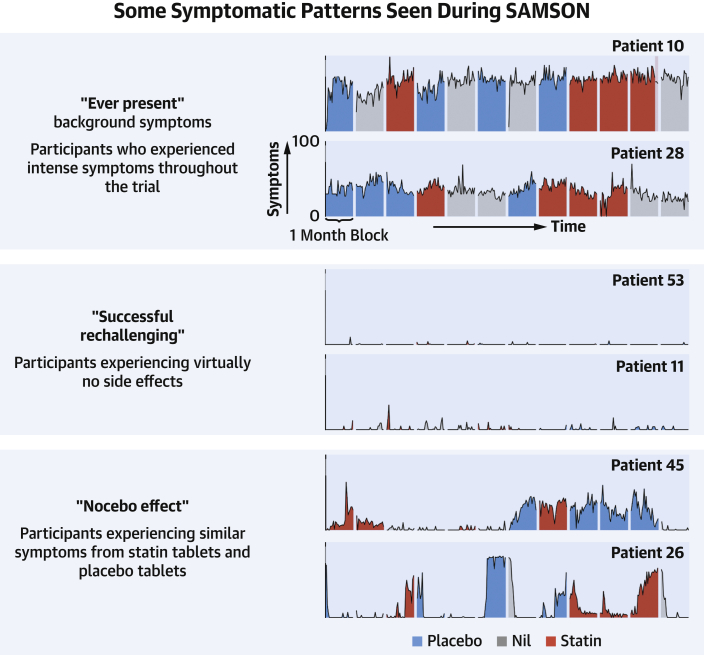
Supplementary browser figure: Howard JP, Wood FA, et al., SAMSON (2021), Figure 2. Copyright 2021 The Authors. Reproduced without modification under CC BY 4.0. Original figure. The print edition retains the chapter 10 summary because the six full traces require an enlarged view.
Work it out: Which explanation is more useful: “It is all in your head,” or “Your symptoms are real. Let us test what is causing them”?
The reasoning: The second. Nocebo describes a contribution from treatment context and expectation. It does not make symptoms fictitious or exclude a genuine pharmacologic adverse effect.
These are synthetic clinical teaching cases, anchored to the guideline and trial evidence in this guide.
A 42-year-old has LDL-C 206 mg/dL and a low 10-year risk estimate. Does the score settle the decision?
Reasoning: severe hypercholesterolemia enters a direct treatment pathway. Evaluate secondary causes and familial hypercholesterolemia. Discuss effective statin-based treatment rather than using low short-term risk to dismiss lifelong LDL exposure.
Muscle aches recur after an unblinded restart, and CK remains elevated after stopping. Is another immediate rechallenge the next step?
Reasoning: No. Evaluate persistent CK elevation and possible injury first. Check interacting drugs, thyroid disease and other causes. Persistent proximal weakness with elevated CK can require evaluation for immune-mediated necrotizing myopathy. Nocebo evidence does not replace this safety assessment.
A patient hears an NNT near 100 and concludes 99 people receive no possible benefit.
Reasoning: NNT summarizes an average risk difference over a specified time. It cannot tell which individual would avoid an event. Give the endpoint, time, and both absolute and relative effects.
A patient with multiple ASCVD events lowers LDL-C substantially on high-intensity treatment but remains above the very-high-risk goal.
Reasoning: a good percentage response can coexist with a remaining treatment gap. Confirm adherence and add appropriate nonstatin therapy to reach the risk-specific goal.
The habit to keep: identify the indication, use a valid effect estimate, address symptoms respectfully, and leave a treatment-and-follow-up plan.
Question-led teaching was inspired by Darrel Francis's public statin discussion (2018). Trial numbers and recommendations are independently sourced from the cited primary publications.
Work it out: What is the central practical message of the evidence?
The reasoning: When statins are indicated, pursue effective, sustained LDL lowering. Use the trial evidence confidently, quantify genuine risks, and adapt treatment so that uncertainty or symptoms do not leave the patient unprotected.