The RV is not a small LV. Thin-walled and adapted to a low-pressure pulmonary circuit. Acute afterload rises can cause dilation, venous congestion and low forward flow. RV dysfunction on imaging is not synonymous with clinical RV failure.
A
RV vs LV — key differences
why the RV fails differently| Property | Right ventricle | Left ventricle |
|---|---|---|
| Wall | Thin, compliant at normal loading | Thicker, adapted to systemic pressure |
| Shape | Crescent, wraps around LV | Conical / elliptical |
| Contraction | Longitudinal shortening + inward free-wall motion + septal contribution | Longitudinal and circumferential shortening + torsion |
| Afterload | Low pulmonary resistance and pulsatile load. Poor acute afterload reserve | Systemic resistance and arterial load |
| Coronary flow | Systole + diastole at normal RV pressure. Pressure loading compromises perfusion | Predominantly diastole |
| Interdependence | Shared septum and pericardium: RV dilation can shift the septum and limit LV filling | |
B
Etiology of RV failure
pressure vs volume vs intrinsic| Category | Causes |
|---|---|
| Pressure overload | PH (Group 1–5), high-risk acute PE, ARDS (hypoxic vasoconstriction), post-cardiac surgery, LV failure → Group 2 PH. → PH guide → PE guide |
| Volume overload | Severe TR or pulmonary regurgitation, left-to-right shunts (ASD, PAPVR), and repaired congenital lesions. → ACHD guide |
| RV infarction | Usually proximal RCA occlusion with inferior STEMI. Hemodynamic severity varies. |
| Intrinsic / myopathic | ARVC, RV-predominant DCM, cardiac sarcoidosis, myocarditis. → ARVC guide |
| Post-LVAD | Early or late RV failure after LVAD. Frequency depends on definition and device era. → LVAD guide |
C
Diagnosis & assessment
echo + hemodynamics| Modality | Key parameters |
|---|---|
| Echo — function | Abnormal: TAPSE ≤17 mm, FAC ≤35%, S′ ≤9.5 cm/s, 3D RVEF ≤45%, free-wall strain absolute magnitude ≤20%. Integrate multiple measures and loading conditions. |
| Echo — size | RV-focused basal diameter ≥41 mm is enlarged. Consider body size. Septal flattening mainly in systole suggests pressure loading, mainly in diastole suggests volume loading. Mixed patterns occur. |
| Echo — pressure | RVSP ≈ 4(TR Vmax)² + RAP. Equals PASP only without RV outflow obstruction. TAPSE/PASP is a coupling surrogate with population-dependent thresholds, not a stand-alone diagnosis. |
| CMR | Reference method for RV volumes and EF. Tissue characterization helps identify the cause. No single LGE pattern establishes ARVC or sarcoidosis. |
| RHC | Integrate RAP, PA pressure, PAWP, cardiac output and PVR. PAPi = (PASP − PADP)/RAP. A value ≤0.9 was studied in acute inferior MI, not as a universal RV-failure cutoff. |
The amber cue shows septal displacement into the LV. Shared septal geometry and pericardial constraint link ventricular filling. Fixed teaching states, not a simulated heartbeat.
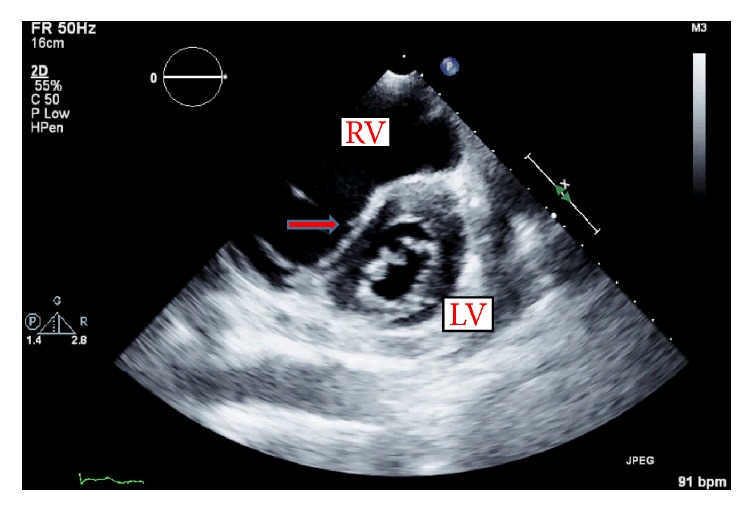
End-diastolic image from an adult with combined RV pressure and volume overload. The red arrow marks the displaced septum. A still image alone does not establish the loading mechanism.
Figure 1, © 2017 Eder Hans Cativo Calderon et al. Case Reports in Cardiology · CC BY 4.0. Whole figure, unchanged.
Treat the trigger while supporting perfusion. Look for PE, RV ischemia, tamponade, infection, arrhythmia and ventilator-related afterload. Follow mental status, urine output, lactate, echo and invasive pressures when needed. Escalate early for persistent shock.
A
Preload optimization
fill only the underfilled RV- Assess first “Preload dependent” means optimally filled, not “give fluid.” Venous congestion can coexist with low systemic output.
- Underfilled if filling pressures are low and congestion absent, try a small crystalloid bolus (for example 250 mL) and reassess. Stop if RAP rises without better output or perfusion.
- Congested use IV loop diuresis with response-guided escalation. Individualize the filling-pressure target using perfusion, renal function and ventricular interaction. Consider renal replacement therapy for refractory overload.
- Distended RV added volume can worsen TR, wall stress and septal shift. Reduce congestion and afterload while supporting arterial pressure.
B
Afterload reduction
lungs + pulmonary vessels + left atrium- Ventilation correct hypoxemia, hypercapnia and acidosis. Intubation can precipitate collapse in severe RV failure. If required, plan hemodynamic support and use lung-protective ventilation with PEEP balancing recruitment against overdistension. Avoid a blanket “lowest PEEP” or permissive-hypercapnia strategy.
- Left-sided pressure treat high PAWP and LV failure. Increased pulmonary blood flow can worsen edema if the LV cannot accept it.
| Therapy | Use and limitation |
|---|---|
| Inhaled NO or epoprostenol | Short-term selective pulmonary vasodilation for a raised-PVR phenotype. Monitor oxygenation, perfusion and delivery. Wean carefully to avoid rebound. They are rescue/support therapies, not proven survival treatments for all acute RV failure. |
| What equivalence means | INSPIRE-FLO randomized 231 adults having heart transplant or LVAD surgery. iEPO and iNO produced similar postoperative RV-failure rates within the prespecified equivalence margin. This does not establish equivalence in every RV-shock cause. |
| Established PAH | Continue essential PAH therapy. Parenteral prostacyclin requires PH expertise. Avoid abrupt interruption. Monitor systemic pressure and oxygenation. Do not apply this pathway to unclassified PH. |
C
Restore pressure, then augment output
continuous reassessment| Agent | Clinical role and cautions |
|---|---|
| Norepinephrine | Common initial vasopressor for hypotensive RV failure. Restore systemic and coronary perfusion while treating the cause. |
| Dobutamine | Augments contractility when low output persists. Titrate cautiously because tachyarrhythmia and hypotension can offset benefit. |
| Milrinone | Inodilator that may help with high pulmonary vascular load. Hypotension and arrhythmia are important risks. Reduce infusion in renal impairment because clearance falls. |
| Vasopressin | Low-dose adjunct for vasodilatory hypotension. Pulmonary effects are dose dependent. It is not universally PVR neutral. |
| Epinephrine | May be required in refractory shock. Monitor tachyarrhythmia, myocardial oxygen demand and lactate interpretation. |
D
MCS for RV failure
choose the whole circulation| Configuration | Selection principle |
|---|---|
| RVAD | Venous/right atrial drainage → PA return bypasses the RV. Requires a pulmonary circuit and LV able to accept the extra flow. An oxygenator-equipped extracorporeal RVAD can also support gas exchange. |
| Impella RP / RP Flex | Model-specific US labeling covers selected acute RV failure after LVAD, MI, transplant or cardiac surgery. Check the full indication and exclusions in the Impella guide and current IFU. |
| VA-ECMO | Provides systemic flow and gas exchange, bypassing the pulmonary circuit. Consider for profound shock or major pulmonary vascular/respiratory failure. Monitor LV loading. → VA-ECMO guide |
RP SmartAssist safety: the 2026 sensor-drift correction warns that displayed flow, placement pressures and PAPi can be inaccurate. Use independent hemodynamics, imaging and model-specific IFU flow ranges before intervention. RVAD/BiVAD selection and management →
Chronic RV failure is a syndrome with several causes. Treat the pulmonary vascular, left-heart, valvular, congenital or myocardial disease that creates the load. Track congestion, exercise capacity, organ function and RV adaptation together.
A
RV failure in pulmonary hypertension
adaptation → decompensation- Adaptation hypertrophy and increased contractility initially preserve output. Later dilation, TR, reduced output and congestion mark failure of adaptation. A single TAPSE/PASP value cannot define the entire transition.
- PAH treatment risk-based specialist therapy. Many patients without major cardiopulmonary comorbidity start an ERA plus PDE5 inhibitor. High-risk disease warrants consideration of combination therapy including IV/SC prostacyclin. Triple oral therapy is not the default initial regimen. → Current PH treatment pathway
- Support relieve congestion without compromising perfusion, correct triggers and preserve sinus rhythm when feasible. Advanced disease requires early transplant-center assessment.
B
RV failure in left heart disease
Group 2 PH- Mechanism elevated LA pressure transmits to the pulmonary circuit. Some patients develop additional pulmonary vascular remodeling. Progression to irreversible high PVR is not inevitable.
- Treatment optimize HF therapy and valve/device indications, then reassess after decongestion. PAH drugs are not routine treatment for PH due to left heart disease. A marked precapillary component or diagnostic uncertainty merits expert review.
C
Post-LVAD RV failure
risk changes with loading and time| Task | Practical approach |
|---|---|
| Predict | Combine clinical state, end-organ function, echo and hemodynamics. EUROMACS-RHF and other scores inform risk but do not rule out postoperative failure. Reassess after optimization. |
| Prevent / recognize | Optimize congestion, oxygenation, rhythm and perfusion. After implantation, check RV size, septal position, LV filling, TR and pump settings. A low-flow alarm does not automatically mean more fluid or more speed. |
| Treat | Correct the cause and loading conditions. Use selected inotropes or inhaled pulmonary vasodilators and consider early temporary RV support before irreversible organ injury. → LVAD guide |
D
RV infarction
reperfuse + preserve AV synchrony- Recognize inferior STEMI with hypotension, elevated JVP and relatively clear lungs is suggestive. Obtain right-sided ECG leads early, especially V4R. The classic triad is not always present.
- Reperfuse urgent coronary reperfusion is central. Give small fluid challenges only when underfilled, with reassessment. Avoid preload-reducing drugs in hypotensive, preload-sensitive patients. Congested RV infarction may still need decongestion.
- Rhythm treat unstable bradycardia or high-grade AV block. Temporary pacing may be needed, ideally preserving AV synchrony. Do not withhold indicated pacing because the RV has infarcted.
- Recovery RV function can improve substantially after reperfusion. Persistent shock still carries high risk and requires escalation.
E
Pulmonary load before heart transplantation
2024 ISHLT stepwise assessment- Trigger for testing PASP ≥50 mmHg plus either TPG ≥15 mmHg or PVR ≥3 WU prompts vasodilator testing during RHC, while maintaining systolic BP >85 mmHg.
- Response a favorable response lowers TPG to ≤12–15 mmHg and PVR to ≤2.5–3 WU without systemic hypotension. These inform a transplant-team assessment, not automatic eligibility.
- If persistent reassess after monitored diuresis/vasoactive therapy and, when appropriate, mechanical LV unloading. Irreversible PH despite this pathway is a contraindication to isolated heart transplant.
Trend the circulation. A pressure, ratio or risk score is a measurement under current loading conditions. Pair it with perfusion, congestion and the response to treatment before escalating therapy.